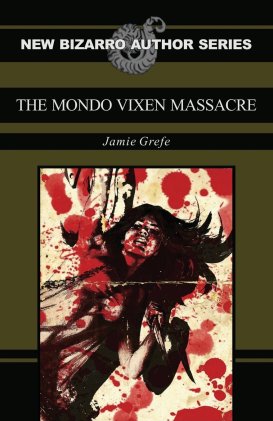
 The following thirty five tips are meant to encourage writers of Bizarro fiction, but could easily be re-purposed to encompass other genres, too. I am not an authority on Bizarro fiction, but a fellow writer seeking to become better. I’m sure there are points here that are glaringly obvious and some that have been said before by others who are ten times as talented as I am. This year, my debut novella, The Mondo Vixen Massacre, was published as part of the Eraserhead Press New Bizarro Author Series. If you prosper from what I have written here, please consider purchasing a copy of my book and/or writing a review. I hope this post will help you.
THIRTY FIVE TIPS ON WRITING BIZARRO FICTION:
1. Read what’s already out there so you know how others do it. For example, read books by authors on Eraserhead Press, Raw Dog Screaming Press, Dynatox Ministries, Grindhouse Press, Rooster Republic Press, Bizarro Pulp Press, Strangehouse Books, Copeland Valley, ATLATL Press, Civil Coping Mechanisms, Lazy Fascist Press, Chupa Cabra House, or James Ward Kirk Fiction (for starters). Also, read works online at Bizarro Central, The Mustache Factor, and other places. Finally, consider purchasing a Bizarro Starter Kit. If you would like your website or publishing house to be listed here, please drop a comment.
2. Realize that Bizarro doesn’t only apply to contemporary authors, although there are many currently working in the genre. Read Kobo Abe, William S. Burroughs, R.F. Lafferty, Russell Hoban, Charles G. Finney or Rabelais. Of course, there are always more. Read widely and voraciously.
3. Watch “cult classic” films and figure out what makes them “cult.” Do they share common elements? What makes them different from each other? Find a gap and use it in your writing.
4. Identify elements in your story that have a certain “cartoon logic.” Experiment and add three “cartoonish” factors to your story.
5. Give a character a trait that is unusual (eg. He has fingernails for teeth).
6. Give a location a trait that is unusual (eg. A shopping mall made of shark-paste or worm skin).
7. Craft a title that is evocative, representative, and imagine that title as printed on the front cover of your book. If you were in a bookstore, would you buy it? Would others? Why or why not?
8. Develop a “logline” for the book you want to write and include those elements that you think make it Bizarro. Write ten of these and choose the least worst one.
9. Most Bizarro is plot-driven, so study the masters of plot construction so you know how to alter and use accordingly. As Kenneth Burke said, “No construction without destruction.” Think, how would I make this better?
10. Believe that your story, with its several Bizarro elements, is real (or real-ish) and when you write it, make it as believable as possible. Even though you are using a certain “cartoon logic, (see #4),” you don’t want the reader to get hung up on that weirdness–you want to seduce the reader in the same way you are seduced by a great book.
11. Some Bizarro presses accept “pitches.” Practice rewriting and reframing your “logline,” so that it tells the story you want to tell in a way that hooks your reader immediately. Make the publisher want to read it by how compelling it sounds.
12. Use music to trigger yourself into certain scenes in your book. Create a playlist that takes you into the world. Some good examples would be Ennio Morricone, Goblin, Tim Hecker, or John Carpenter. Film soundtracks tend to work well.
13. Re-examine your plot and make sure it’s how you want it to be, but don’t worry if it changes or mutates into something else. Your characters might be pulling you in a different direction. Lean to listen to those pulls to find out which ones are most compelling. Trust your characters when they start talking through you.
14. Read more Bizarro fiction (#1) and take notes on structure, tone, and Bizarro elements in the story, and let yourself be pulled in while still keeping an eye on style. If you are not pulled in, figure out what’s keeping you from being pulled in and use that knowledge to write your own story so that a reader who you don’t know will be moved by your story.
15. Don’t listen to any music while you write. Use silence as your guide and allow your imagination to spill itself onto the page, while still holding to the story you wish to tell. Fill your mind with the scene so that you and the scene are seamless. If you are so inclined, listen to “white noise” to help still outside distractions.
16. Always read your manuscript from the beginning, because there are glaring holes and grammatical errors and repeated words that don’t work well and a hundred other problems that you didn’t catch, because you were so deep into the writing. Find those mistakes and fix them and fix them again and again and again.
17. Read something that is not Bizarro, but something that is beautiful to you (of course, it could be Bizarro). Figure out what it is about that book that you love so much and use those tools in your own writing. Learn to actively read a book by writing in it. Use different color pens to highlight different elements. Every time you read it and mark it up, it will be different.
18. Pitch your story to a friend or family member, and then pitch your story to a stranger or a casual acquaintance. Get good at pitching your story, but don’t forget to write.
19. Take a walk and think yourself through the story. Think yourself as a character in the story and see the story happen, feel certain decisions and let them linger and pass. Can you hear the world of your imagination? The next time you write, try to recall that reflection and see if it works on the page.
20. Start small. Write flash fiction (under 1000 words). Turn your flash fiction piece into an expanded short story and then aim for a novella length project. If you are not prepared to tackle a novel, learn to prepare yourself. Or, dive in anyway. The results of your effort might prove fruitful. You will learn a lot about yourself by undertaking and completing the process.
21. Learn to finish your projects. Having a notebook or file full of ideas is great, but finishing a story or a novella or even a novel is an accomplishment. Even better is having a notebook full of ideas and then turning some of those ideas into completed works.
22. Share your story with other writers who will provide honest constructive feedback. Read their stories, too, and do the same for them. Don’t simply praise them, but develop a healthy relationship with the purpose of improvement. Education doesn’t always happen in a classroom.
23. Hire a professional editor to comb over your manuscript. Garrett Cook offers his services for a reasonable price. His output in the Bizarro world is quite astounding. Consider hiring him for a project. And/or consider taking a LitReactor class. I took one and it was definitely worth every penny.
24. Always strive to out-do yourself in your writing. A published piece is nice to refer to (and, yes, is an accomplishment), but is no indication of what you are working on today. You are either getting better or worse. There is no middle ground.
25. Read Bizarro fiction (#1) and figure out what stories are yet to be told. Don’t write something weird just to write something weird, but write something weird, because that weirdness, to you, isn’t so much weird as it is beautiful and worth writing about. It is a story you have to tell.
26. If you don’t think a story is working, go back to the drawing board and analyze where you went wrong and fix it. Maybe the real story is not how you are pushing it to be. Try to feel for where the drama and tension are the tightest.
27. Study a video game and use those elements in your story. See: Eraserhead Press 2013 NBAS or William Pauley III’s THE BROTHERS CRUNK for examples.
28. Study those “cult” films (see #3) and write as if you were the director of one of those films. See D. Harlan Wilson’s PECKINPAH for inspiration on utilizing film in an interesting and unique way.
29. Study paintings and photographs for inspiration. I have tried Alan Clark’s Bizarro Writercizes in the classroom to great success. Use one of Clarke’s paintings for inspiration.
30. Study the plots of three books that you like and then imagine those three plots crashing together in the same world. Now, without copying those elements outright, but instead using them in a slightly different way, write that story.
31. Similarly, learn to blend genres. That is, use the best tropes from different genres and add them to your story. Instead of writing a vampire story that only plays on common vampire tropes, have your vampires be obsessed with toes and elephants and speak only in sonnet form.
32. After you’ve written your Bizarro story and possibly used some of these tips, submit it for publication. If it gets rejected and the publisher is willing to explain why, learn from that. Ultimately, it is the publisher’s decision.
33. Reach out to other Bizarro writers and review their books. Join the conversation online or in person. Bizarro writers, from my experience, are quite friendly, professional and open to dialogue.
34. Attend BizarroCon. I wasn’t able to attend this year, but the workshops, the readings, the various comments from other authors has been outstanding and many people have spoken highly of it.
35. Read more Bizarro fiction and read anything and everything that moves you, whether its Bizarro or not. The words and styles of others will seep into your own style over time. Always learn to be a better reader.
UPDATES:
HERE is “The Definitive Bizarro Film List” by G. Arthur Brown, author of KITTEN
HERE is an older online class taught by Bizarro writer, Bradley Sands. His description of Bizarro is very useful to aspiring writers of the genre.
Thank you for reading. If you’d like to add to the list, please add comments below.






 percy4d, and

 The Eyeslit-Crypt
Reply